

The HAFT Four for X-Plane 12: The Best is Yet to Come
By: Frank White /FSS Editor
July 25, 2026
The Pursuit of Perfection: A Return to Serious Simulation
As someone who returned to flight simulation in 2017 to resume real-world Cessna 172 training, I quickly learned the value of a study-level aircraft. While the sim world's current news cycle is heavily dominated by MSFS 2024, my deep immersion into long-haul flying with the FlightFactor 777-200ER reminded me why X-Plane remains a powerhouse for serious simmers. The sheer depth of the 777 compelled me to pick up the freighter and -300ER variants, proving that high-fidelity airliners are X-Plane’s true bread and butter.
And who can forget the Challenger 650 by Hot Start? Today, it is the only aircraft that allows one to take on real-world passengers in a virtual environment, fully simulating the experience of dealing with an FBO for fuel and interacting with the ground crew. Masterpieces like the 777 and Challenger 650 are why we stay, but the future is even brighter. Let's examine the "HAFT Four" anticipated airliners. While we wait for release dates, here is a look at the developers behind them (Hot Start, Airfoillabs, FlightFactor, and ToLiss) and why we think these new offerings will become iconic aircraft for X-Plane.
Airfoillabs (AFL) - Boeing 737 MAX 8
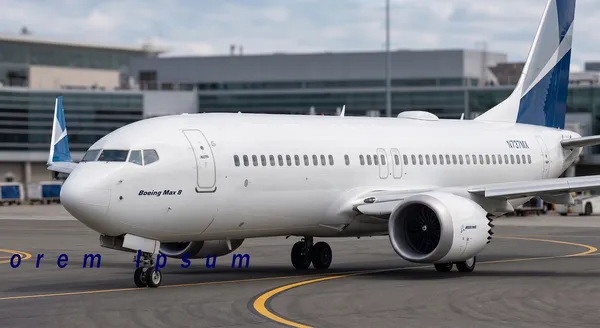
When AFL released their C172, it was considered study-level from the start, and they followed it up with a magnificent King Air 350. Their upcoming 737 MAX 8, which is about 80% complete toward its first beta, takes their development philosophy to the extreme. Developed entirely by just two people, AFL models the "why" instead of the "what". Every bus, relay, and pump is simulated as a real component. In the AFL MAX, the "BAT DISCHARGE" light doesn't illuminate because a scripted failure menu triggered it; it comes on because their custom electrical model actually measured a net negative current at
Hot Start - Airbus A220
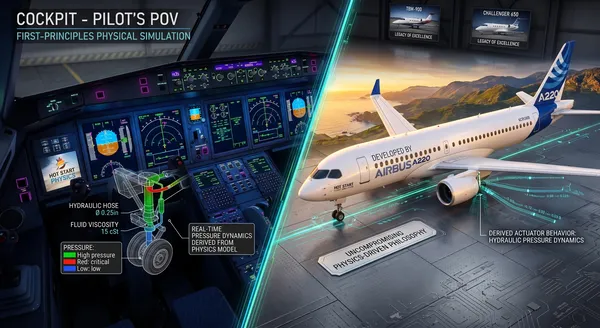
My introduction to Hot Start was the TBM-900, followed by the Challenger 650—which continues to hold the mantle of "best plane ever built for flight simulation" for many users. Lead programmer Sašo Kiselkov, aka Totoritko, builds aircraft from first physical principles rather than using standard lookup tables. Everything in a Hot Start aircraft has a cause and effect: to simulate hydraulics, for instance, Kiselkov programmed the exact physical diameter of the hydraulic hoses and the real-world viscosity of the fluid. Instead of using hard-coded data to dictate how an actuator should behave, this first-principles physics approach naturally derives the correct real-world behavior and pressure dynamics of the aircraft's components. With the A220, we are eagerly anticipating how Hot Start will apply this uncompromising, physics-driven philosophy to a commercial airliner.
FlightFactor (FF) - Boeing 787 Dreamliner
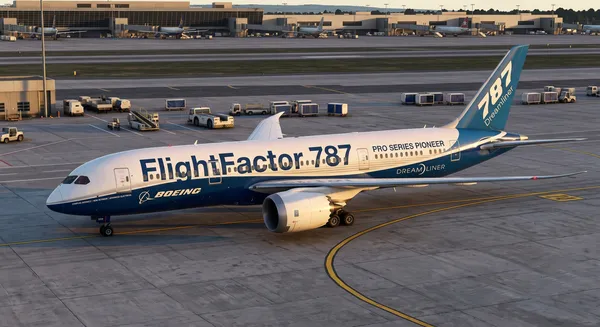
Announced as the pioneer of their new "Pro" series, the FlightFactor 787 aims to conquer unprecedented heights in complexity and usability. Building a modern Dreamliner is a massive undertaking, mostly because it cannot simply be ported from their highly successful 777v2. The real-world 787 features an incredibly advanced electrical architecture and networked cockpit displays that differ significantly from earlier Boeing designs. The team is actively focused on implementing these complex avionics while crafting brand-new interior models and cabin artwork.
FlightFactor & ToLiss - Airbus A350 v2
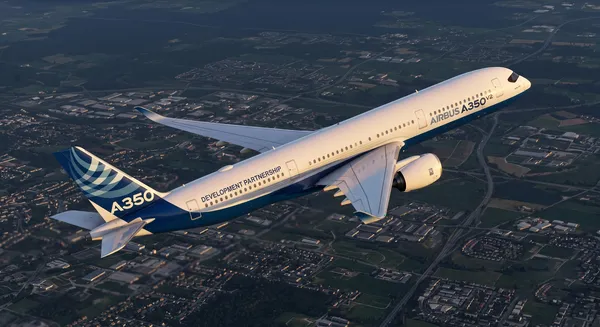
If there was ever a flight sim equivalent to "Avengers Assemble," this is it. FlightFactor and ToLiss, historically competitors in the X-Plane Airbus market, officially announced their collaboration on a ground-up A350 v2 for X-Plane 12 in February 2024. As someone who loves the FF A350 v1 and the ToLiss A321 NEO, the prospect of these two titans joining forces is thrilling. FlightFactor is handling the extensive 3D modeling and the Onboard Information System (OIS), while ToLiss brings their renowned expertise in deep Airbus systems programming. This superhero team-up proves that the X-Plane community is far from dead in the water, or should I say, stalled.
