
Piper Cherokee 140
Editorial Overview & Systems Analysis
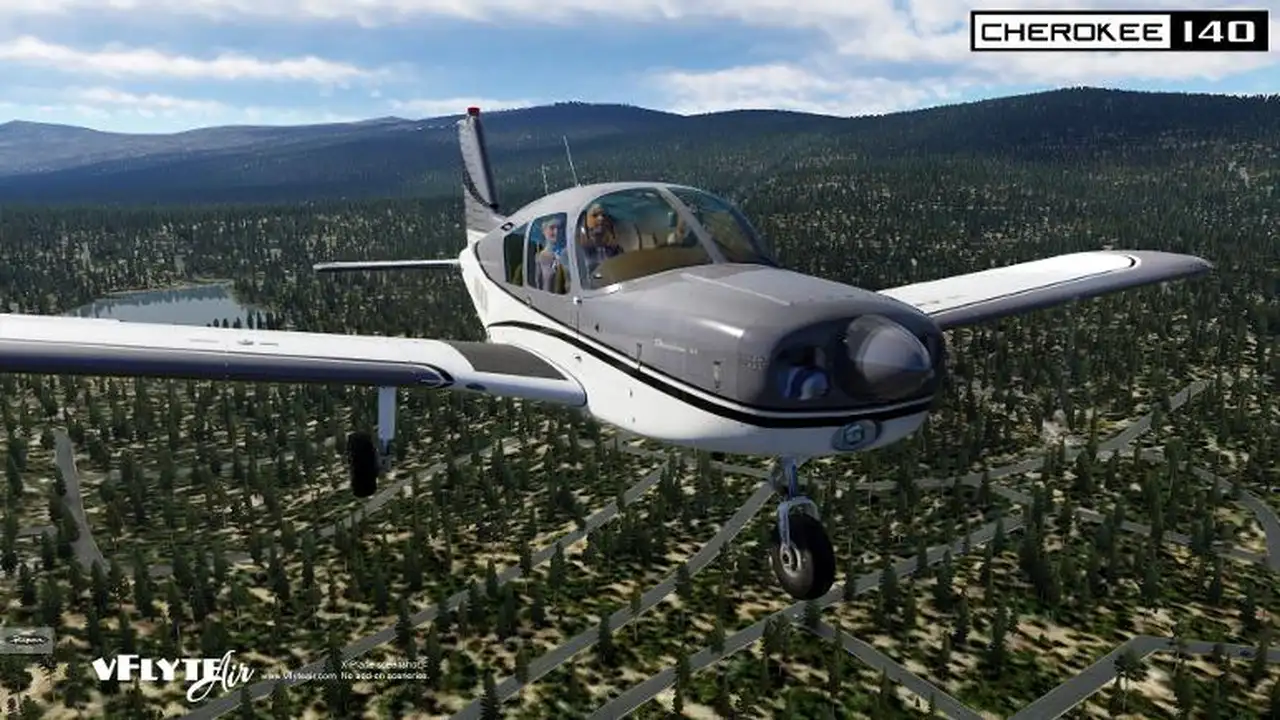
The Piper Cherokee 140 (widely cataloged across training fields and flight simulation as the Cherokee 140, PA-28-140, PA28-140, PA-28, or affectionately as the "Hershey Bar Cherokee" and "Baby Cherokee") is one of the most celebrated ab-initio trainers and personal runabouts in aviation history. Introduced in the 1960s to compete head-to-head with the Cessna 172, the low-wing PA-28-140 won over generations of private pilots with its docile stall characteristics, constant-chord slab wing, and low center of gravity. Developer vFlyteAir Simulations completely rebuilt the airframe from scratch natively for X-Plane 12. Known across the community as the vFlyteAir Cherokee, this rendition captures the classic trainer's charm while adding deep customization and modern avionics options.
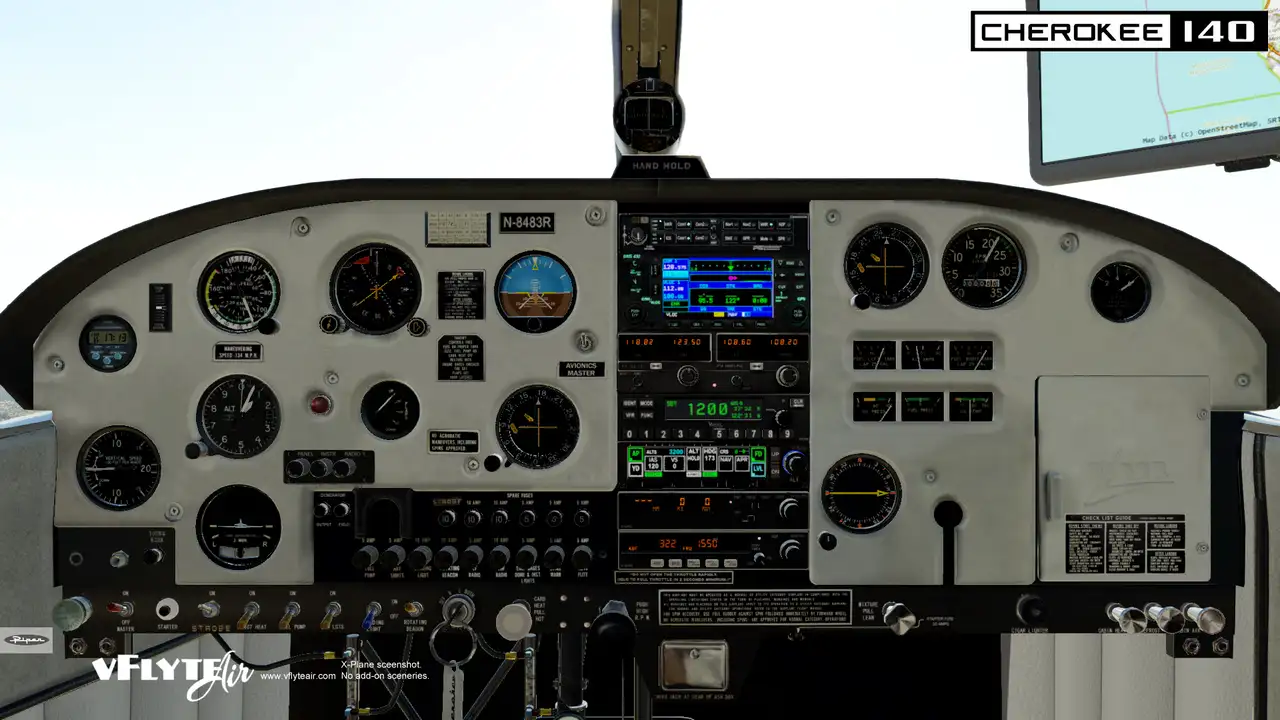
The flight deck accommodates multiple eras of flying through an interactive options menu that swaps instrument layouts on the fly without reloading the flight. Pilots can select between three configurations: a vintage VFR trainer with traditional mechanical dials and basic VOR navigation; an analog IFR layout with an HSI; or a modern glass cockpit featuring a custom Aspen E5 electronic flight display paired with a touchscreen Bendix/King KFC 230 digital autopilot. The aircraft includes working circuit breakers, an authentic overhead manual flap Johnson bar, and an interactive 3D preflight walkaround where pilots visually dip the fuel tanks, check the engine oil level, remove wheel chocks, and inspect pitot covers.
In X-Plane 12, the Cherokee 140 showcases the platform's blade-element flight dynamics, native windshield rain and ice shaders, and photometric night lighting. Powered by a carbureted Lycoming O-320 engine producing 150 horsepower, the flight model incorporates realistic engine starting logic; improper priming, incorrect throttle crack, or neglecting carburetor heat in humid descent conditions will cause sputtering or carburetor ice stalls. Hand-flying the Cherokee 140 delivers the classic ground-effect cushion of the Hershey-bar wing, settling smoothly onto the tarmac at 55 to 60 knots indicated airspeed.
Primary Missions & Operational Roles
-
Ab-Initio Primary Flight Training: Practicing pattern work, steep turns, slow flight, and stall recoveries in a docile low-wing trainer that has introduced thousands of real-world pilots to aviation.
-
Classic 1960s/70s Raw-Data VFR Pilotage: Selecting the vintage trainer panel to practice dead reckoning, sectionals, pilotage landmarks, and VOR radial navigation without GPS map assistance.
-
Single-Pilot Light IFR Touring: Utilizing the modern Aspen E5 glass panel or analog HSI panel coupled with GPS units to shoot non-precision and precision instrument approaches into regional fields.
-
Grass Strip & Short-Field Backcountry Hops: Operating into turf strips and small municipal airfields, utilizing the manual mechanical flap handle for instantaneous flap dumping during short-field rollout.
Key Highlights
- Three Switchable 3D Panel Configurations: Seamless on-the-fly swapping between modern Aspen E5 glass, analog IFR, and vintage VFR trainer layouts to suit any training scenario.
- Interactive Preflight Walkaround Inspection: Exterior 3D check sequence allowing pilots to visually check fuel levels with dipsticks, inspect engine oil, pull chocks, and remove cowl plugs.
- POH-Accurate Engine Start & Carburetor Logic: Custom engine start model demanding precise priming, mixture positioning, and throttle settings, alongside authentic carburetor icing vulnerability.
- Integrated 3D AviTab & Dynamic Weight Menu: Built-in cockpit tablet support, comprehensive weight-and-balance load manager with real-time center-of-gravity graphs, and normal checklists.
- Immersive FMOD2 Spatial Soundscape: Detailed Lycoming O-320 engine audio recordings, interior switch clicks, flap handle ratchets, airframe buffeting, and plug-in cockpit headset noise attenuation.
Quirks & Limitations
- Modest Climb & Cruise Performance: Powered by a 150-horsepower engine spinning a fixed-pitch propeller, climb rates taper noticeably above 6,000 feet, and cruise speeds top out around 105 to 115 KTAS.
- Carburetor Icing Sensitivity in XP12 Weather: True to carbureted Lycoming engines, failing to engage carburetor heat during low-power descents in moist air will quickly lead to RPM decay and engine stoppage.
- Ground Effect Float on Fast Approaches: The wide Hershey-bar low wing creates a noticeable ground cushion; carrying excess airspeed across the threshold can result in extended floating past the touchdown zone.
- Manual Trim Wheel Positioning: The low-mounted center-console pitch trim wheel requires deliberate peripheral camera panning or assigned hardware trim axes to adjust easily during high-workload landings.
Community Ratings & Feedback
Want to rate this flight deck or leave a review? Log In or Create an FSS Account to post your review.
Be the first simmer to leave a flight deck review and community score for this airframe.
Systems & Integrations
Video Showcases
Help Improve the Directory
Notice missing details, broken links, or incorrect pricing? Submit a correction to our Hangar Mods.
Suggest an Update