
ViperJet eX
Editorial Overview & Systems Analysis
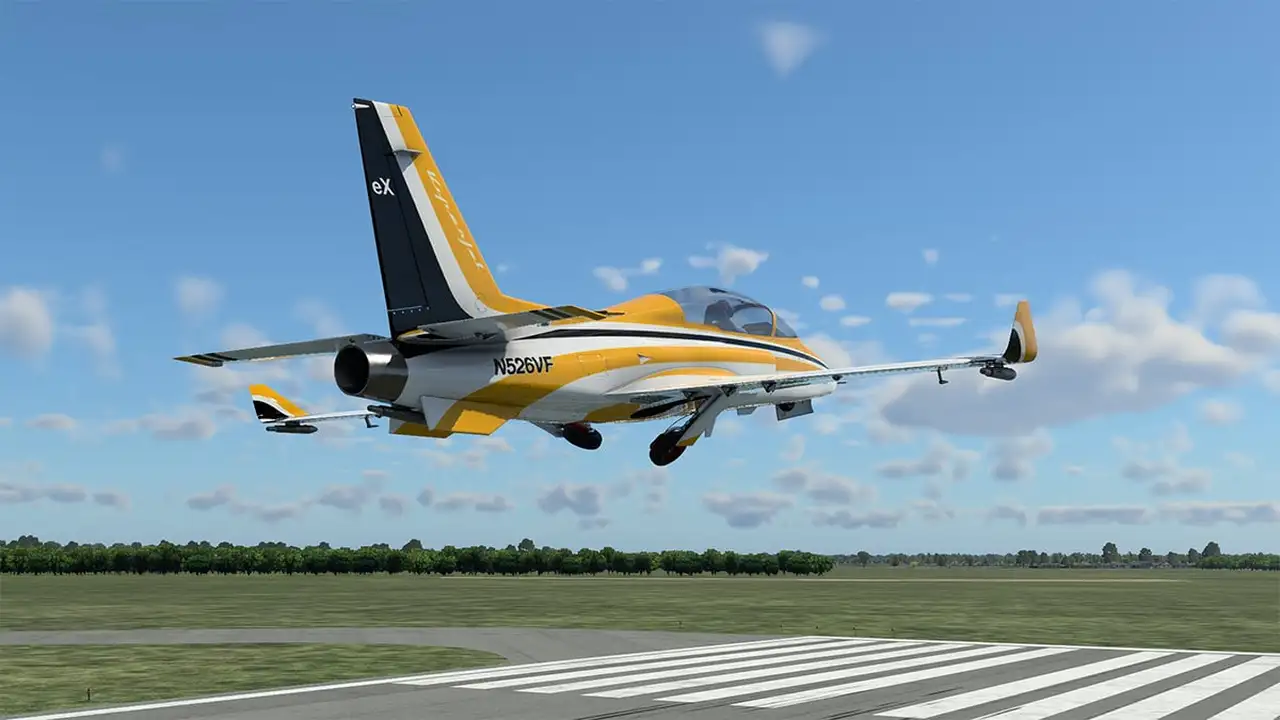
The ViperJet eX (widely cataloged across airshow circuits, experimental aviation circles, and simulation hangars as the ViperJet, Viper Jet, Aerobask ViperJet, and Viper Aircraft eX) occupies an exhilarating niche in modern aviation: the homebuilt civilian fighter jet. Conceived by brothers Scott and Dan Hanchette in Washington State, the ViperJet was engineered to give private aviators the swept-wing aerodynamics, tandem bubble canopy, and hair-raising climb performance of a military fast-jet trainer without military logistics or multi-million-dollar acquisition costs. Featuring an all-composite carbon-fiber airframe, blended winglets, and an aft-mounted General Electric turbojet, the eX cruises at speeds exceeding 330 KTAS with a jaw-dropping initial climb rate of 6,000 to 8,000 feet per minute. Rebuilt natively from the ground up for X-Plane 12 by Aerobask, this add-on brings a true civilian pocket fighter to desktop flight simulation.
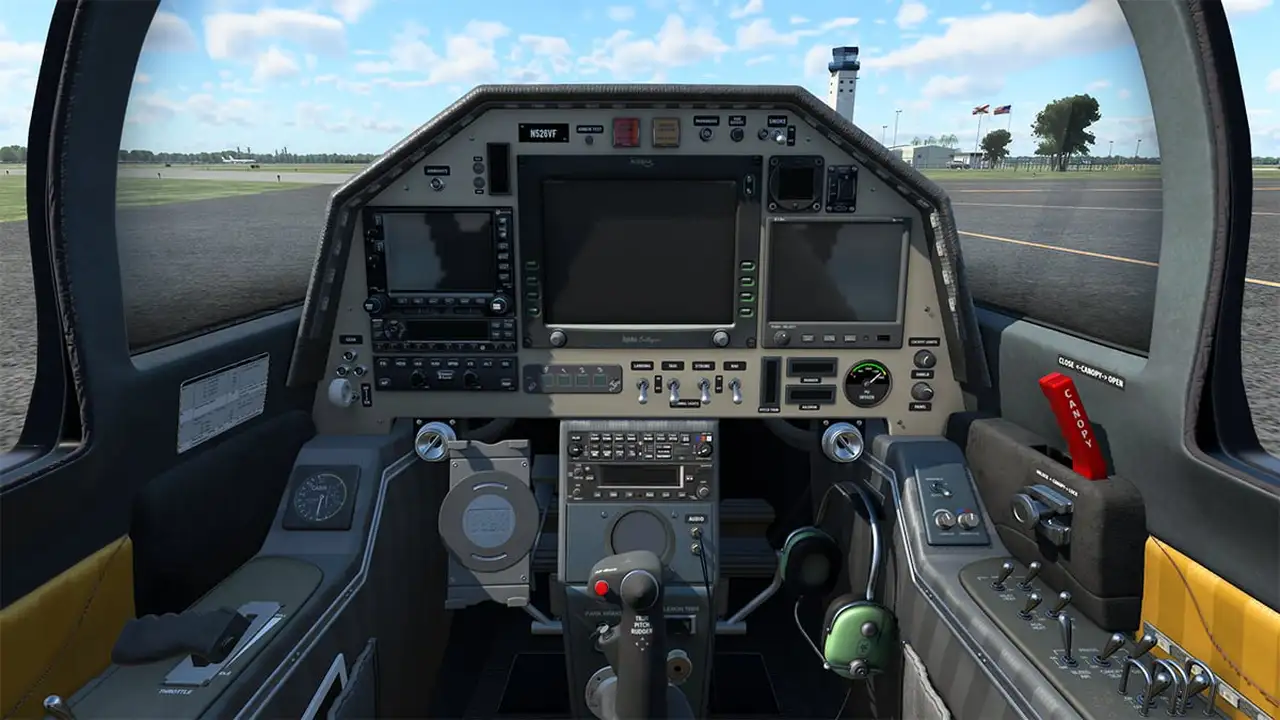
In the flight deck, Aerobask pairs high-performance tandem seating with an advanced glass-panel avionics suite. The front cockpit is anchored by the Avidyne EXP5000 primary flight display featuring OscarPilote synthetic vision and moving-map routines, backed by an authentic DFC90 digital autopilot. A distinctive operational highlight is the collimated Head-Up Display (HUD), which projects flight director symbology, pitch ladders, airspeed, altitude, and flap states directly into the pilot's forward field of view. Engine health is monitored via an MVP-50 digital instrument, while automated flap management is handled by an interactive ACI e-Flaps controller. Systems depth includes functional circuit breakers with configurable component reliability, active canopy latch and pneumatic pressurization seal mechanics, wing-tip smoke emitters with selectable airshow colors, and native support for third-party TDS GTNXi and Reality XP GTN touchscreens.
In the X-Plane 12 flight environment, the ViperJet eX delivers an electrifying flight profile tuned by flight-model specialist X-Aerodynamics. Pushing the throttle forward unleashes immediate, neck-snapping acceleration, blasting through 250 KIAS within seconds and sustaining vertical climbs that easily outpace production turboprops and business jets. Aerobatic handling is crisp and responsive throughout its +6g / -3g structural envelope, retaining excellent roll authority and stability. However, harnessing jet performance in a clean composite airframe demands disciplined energy management: with its low parasite drag and fighter-like profile, descending from the flight levels requires proactive planning. Pilots must pull thrust to idle and deploy the speedbrakes well in advance of the terminal area to decelerate to gear-extension speed without busting pattern altitude or overspeeding the airframe. Evaluated under our directory classification rubric, the simulation earns a solid Procedural tier: its authentic HUD optics, functional breaker panel, tuned high-g flight dynamics, and Daniela Rodriguez Careri FMOD soundscape make it one of the most thrilling sport jets available in XP12.
Primary Missions & Operational Roles
-
High-Speed Personal Jet Cross-Country: Cruising between Flight Level 280 and Flight Level 350 at 330 to 350 KTAS, covering 700 to 900 nautical mile personal hops with true jet speed.
-
Airshow Aerobatics & Formation Flying: Executing precise high-g loops, vertical rolls, cuban eights, and tactical low-level breakaways utilizing the integrated aerobatic smoke system and collimated HUD.
-
Fighter Transition & Tactical Pattern Training: Practicing military-style overhead break arrivals, high-speed circuit entries, and speedbrake-moderated energy descents.
-
Coupled Glass-Deck IFR Navigations: Flying RNAV, VOR, and precision ILS approaches down to CAT I minimums using the Avidyne EXP5000, DFC90 digital autopilot, and Garmin GNS 530 or optional TDS GTNXi navigator.
Key Highlights
- High-performance experimental jet capabilities, achieving 330+ KTAS cruise speeds and 6,000+ fpm climb rates with flight physics tuned by X-Aerodynamics.
- Collimated Head-Up Display (HUD) displaying pitch ladders, flight vector symbology, speed, altitude, and autopilot status.
- Comprehensive glass avionics suite featuring Avidyne EXP5000 with synthetic vision, DFC90 digital autopilot, MVP-50 engine monitor, and AOA Pro indexer.
- Interactive circuit breaker panel with user-configurable component failure reliability in the tablet menu.
- Functional airshow smoke system with selectable smoke emitter colors operable directly from the cockpit console.
- Full FMOD2 acoustic suite engineered by Daniela Rodriguez Careri featuring authentic turbojet whine, high-speed canopy airflow, and tactile switchgear clicks.
- Cockpit AviTab tablet integration providing live moving charts, fuel and weight loading, canopy operations, and ground servicing equipment.
Quirks & Limitations
- Extremely low aerodynamic drag requires early power reductions and speedbrake deployment during descent; descending too steep will rapidly cause airspeed overshoots beyond Vmo (320 KIAS).
- High fuel consumption at low altitudes requires pilots to climb into the mid-to-high flight levels on cross-country hops to preserve fuel reserves.
- Fighter-style tandem seating restricts direct rear-seat instrument visibility from the front seat, requiring quick-look camera views to inspect secondary panels.
- High-detail 4K PBR interior textures combined with dual glass displays and the HUD perform best on graphics cards with 8 GB or more VRAM.
- Does not support automated direct SimBrief OFP flight plan uplink.
Community Ratings & Feedback
Want to rate this flight deck or leave a review? Log In or Create an FSS Account to post your review.
Be the first simmer to leave a flight deck review and community score for this airframe.
Purchase & Download
X-Plane.org storeSystems & Integrations
Video Showcases
Help Improve the Directory
Notice missing details, broken links, or incorrect pricing? Submit a correction to our Hangar Mods.
Suggest an Update