
Epic Victory
Media Gallery
Editorial Overview & Systems Analysis
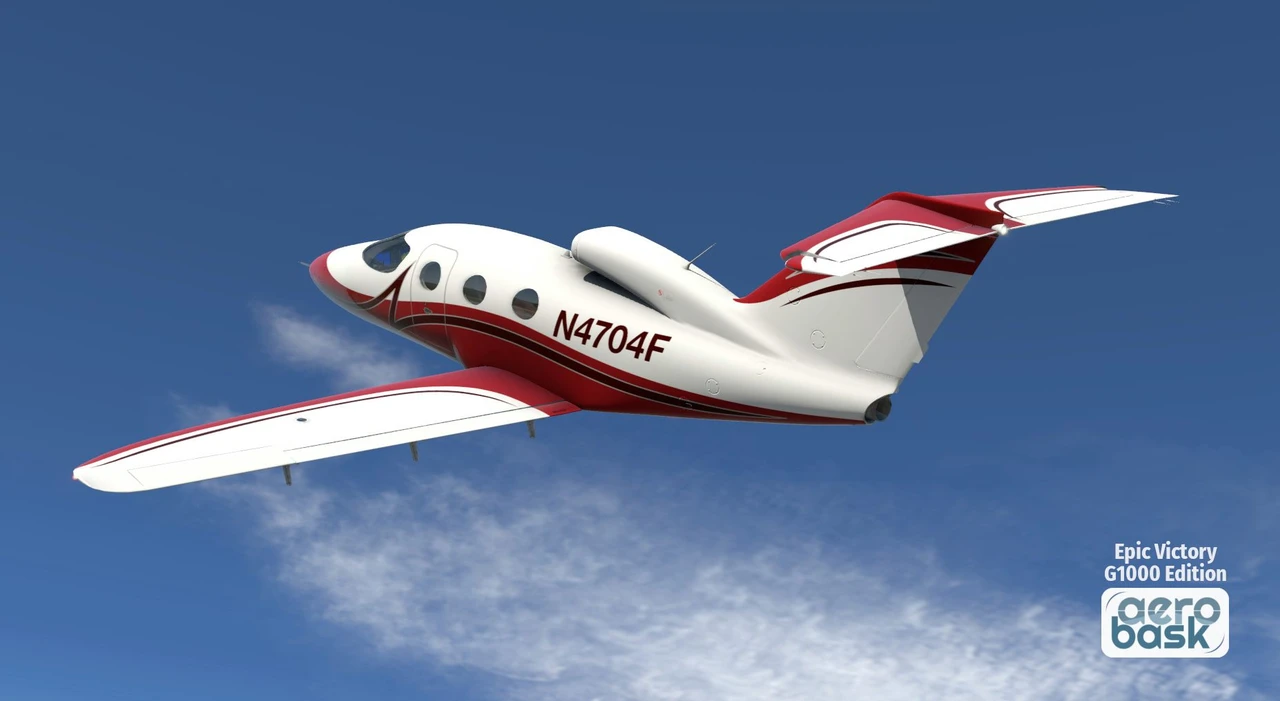
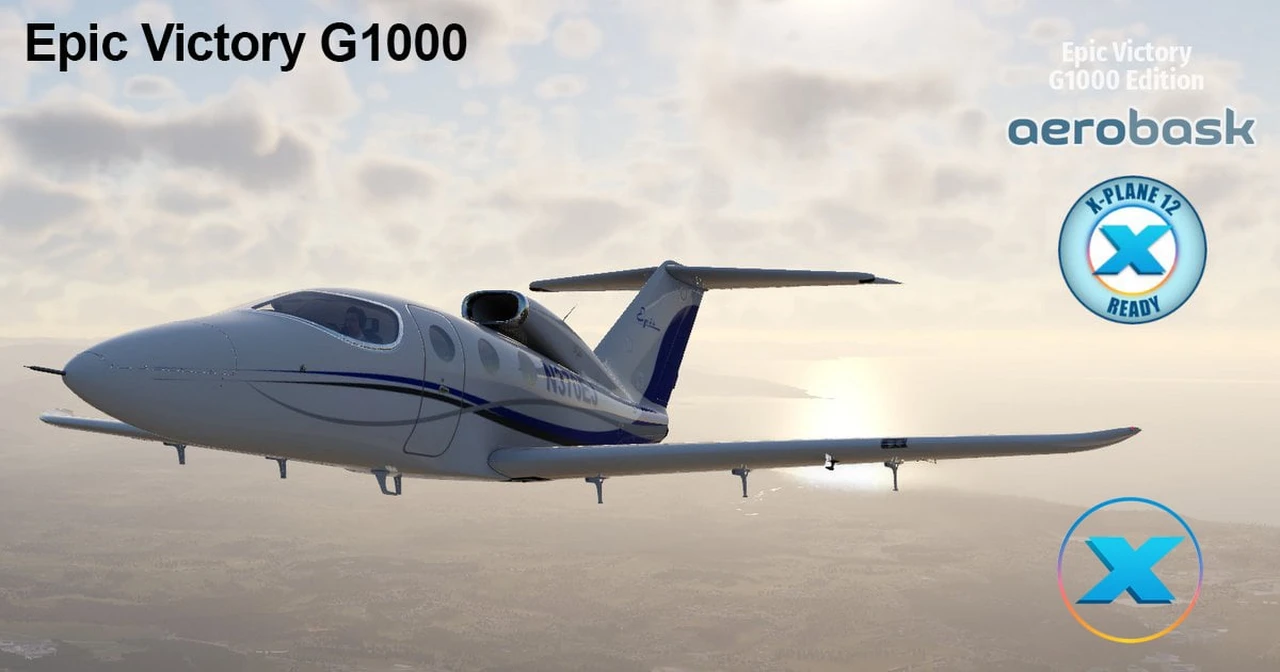
The Epic Victory (widely cataloged across corporate flight hangars, experimental aviation circles, and simulation communities as the Victory, Victory Jet, Epic Jet, and Aerobask Victory) represents one of the boldest chapters of the early 2000s Very Light Jet (VLJ) revolution. Conceived in Bend, Oregon, by Epic Aircraft as an owner-flown, single-engine personal jet, the Victory was engineered to offer executive turbine speed, pressurized comfort, and high-altitude efficiency in an experimental-class package. Wrapping an aerodynamically slick, all-carbon-fiber composite airframe around a muscular Pratt & Whitney Canada PW617F-E turbofan producing roughly 1,695 pounds of thrust, the Victory was designed to cruise at over 320 KTAS while operating comfortably out of 3,000-foot runways. Rebuilt natively for X-Plane 12 by Aerobask, this add-on brings an agile, pocket-rocket personal jet to desktop hangars.
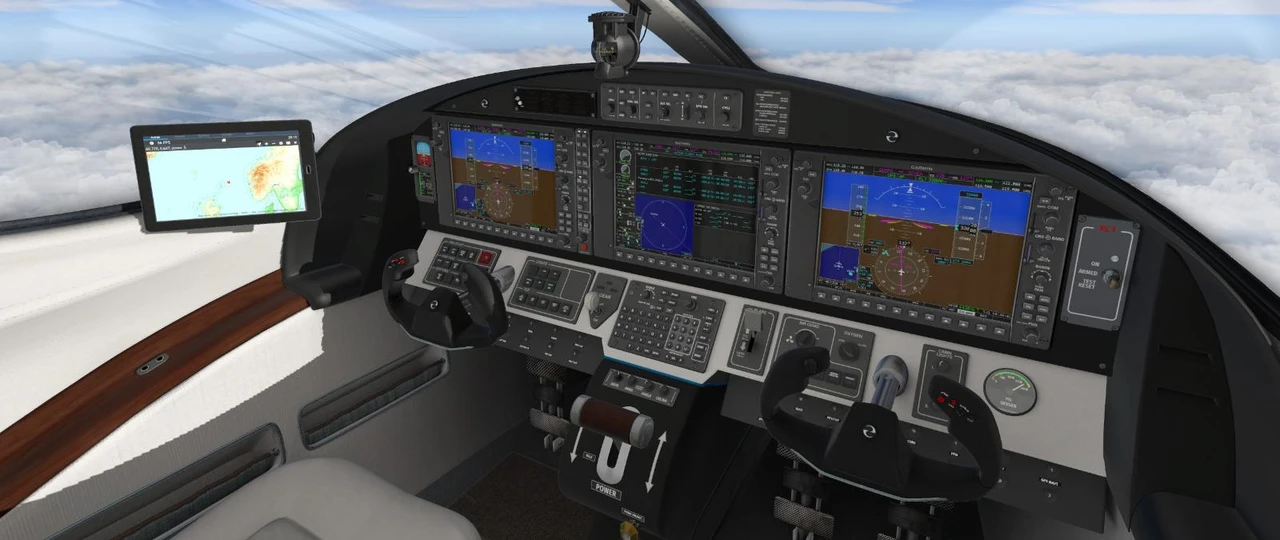
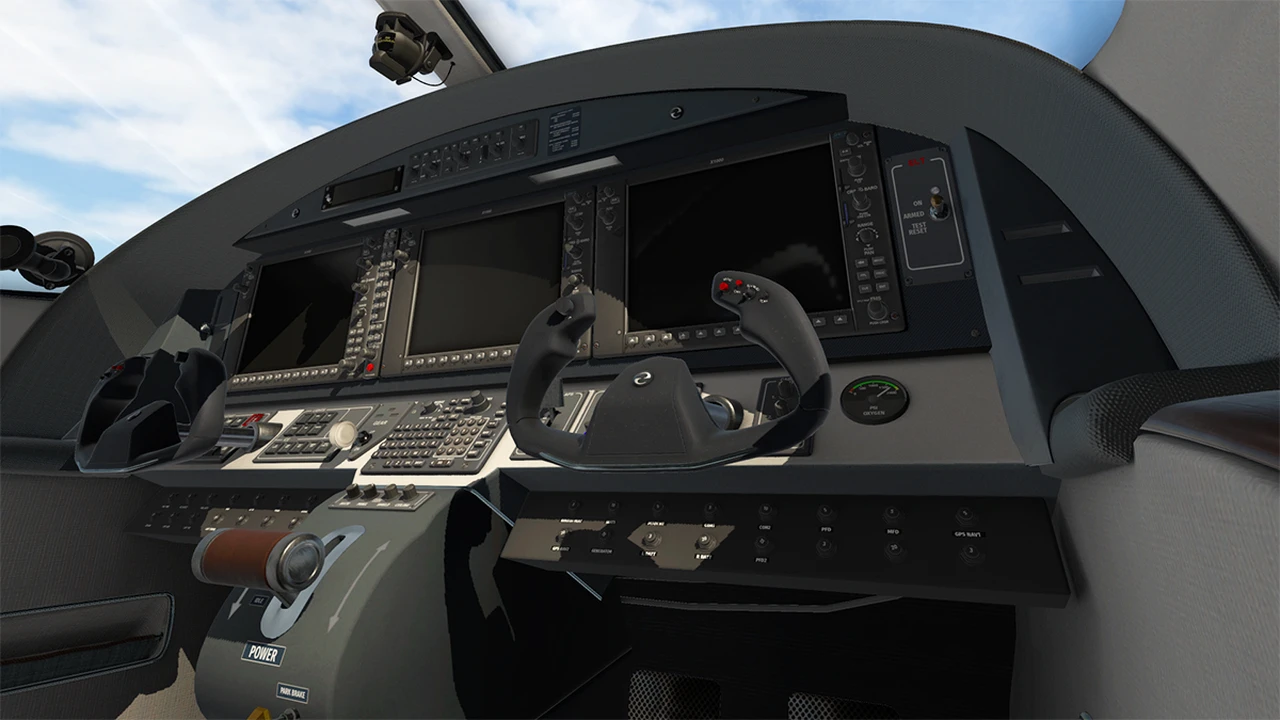
On the flight deck, Aerobask pairs its signature high-resolution visual modeling with an enhanced Garmin G1000 glass suite. The avionics feature custom engine indication system (EIS) pages tailored specifically to PW617F turbofan parameters, OscarPilote synthetic vision, and an authentic Mid-Continent MD302 standby attitude module. Aerobask integrates practical quality-of-life systems for single-pilot operations: the pedestal features a clickable GCU477 alphanumeric keypad with physical keyboard text capture for fast waypoint routing, while the GFC 700 digital autopilot incorporates a custom Cruise Speed Control (CSC) mode—functioning as an automated FADEC-based autothrottle. Systems depth is reinforced by functional circuit breakers with configurable reliability, active windshield de-icing and rain shaders, a simulated oxygen system, and persistent state memory that saves switch and payload configurations between reloads.
In the X-Plane 12 flight environment, the Victory delivers the spirited acceleration and responsive handling that define the single-engine VLJ category. Powered by the PW617F turbofan, the aircraft climbs eagerly at 3,000 to 4,000 feet per minute, reaching its ceiling of Flight Level 280 in roughly 10 minutes and settling into an honest 310 to 325 KTAS cruise. Like its real-world counterpart, flying the Victory requires disciplined energy management: with a composite airframe designed for minimal parasite drag and no dedicated wing speedbrakes, descending from the flight levels demands forward planning. Pilots must reduce power well in advance of the terminal area and use landing gear extension (Vlo 180 KIAS) as an aerodynamic brake to configure for approach without ballooning. Evaluated under our directory classification rubric, the simulation earns a solid Procedural tier: its functional circuit breakers, custom CSC autothrottle logic, authentic FMOD soundscape, and balanced flight model deliver an exhilarating corporate jet option for XP12.
Primary Missions & Operational Roles
-
High-Speed Personal & Executive Jet Touring: Cruising at Flight Level 240 to Flight Level 280 at 320 KTAS, covering 1,000 to 1,200 nautical mile non-stop legs with light-jet speed and single-engine operating economy.
-
Single-Engine VLJ Energy & Descent Planning: Mastering idle-thrust descents, speed management, and terminal deceleration in a clean composite jet lacking wing spoilers or thrust reversers.
-
Single-Pilot Glass Deck IFR Navigations: Executing coupled RNAV, LPV, and precision ILS approaches down to CAT I minimums utilizing the G1000 suite, GCU477 alphanumeric keypad, and GFC 700 autopilot.
-
Owner-Flown Experimental Jet Operations: Experiencing the high thrust-to-weight ratio, crisp stick-and-rudder response, and single-lever FADEC turbine handling of an experimental personal jet.
Key Highlights
- High-speed personal jet performance, achieving 320+ KTAS cruise speeds and 3,500+ fpm initial climb rates powered by the Pratt & Whitney Canada PW617F-E turbofan.
- Fully integrated Garmin G1000 glass flight deck featuring custom PW617F engine pages, synthetic vision, and console-mounted GCU477 alphanumeric keypad.
- Advanced GFC 700 digital autopilot equipped with a custom Cruise Speed Control (CSC) autothrottle mode tied into the FADEC logic.
- Functional circuit breaker panel with user-configurable component failure reliability in the tablet menu.
- Immersive FMOD spatial acoustic suite engineered by Daniela Rodriguez Careri featuring authentic turbofan whine, high-speed canopy airflow, and tactile switchgear clicks.
- Cockpit AviTab tablet integration providing moving maps, weight and balance loading, ground servicing toggles, and persistent airframe state memory.
Quirks & Limitations
- Exceptionally low-drag composite airframe and lack of wing speedbrakes require early descent planning; descending too steep will quickly cause airspeed overshoots beyond Vmo (265 KIAS).
- Low-mounted engine centerline produces a mild pitch-up moment when rapidly advancing power from flight idle to maximum continuous thrust during go-arounds.
- Core G1000 architecture relies on standard simulator navigation databases, lacking direct automated SimBrief OFP flight plan uplink.
- High-detail 4K PBR interior textures combined with dual glass displays perform best on graphics cards with 8 GB or more VRAM in dense scenery environments.
Community Ratings & Feedback
Want to rate this flight deck or leave a review? Log In or Create an FSS Account to post your review.
Be the first simmer to leave a flight deck review and community score for this airframe.
Purchase & Download
X-Plane.org storeSystems & Integrations
Video Showcases
Help Improve the Directory
Notice missing details, broken links, or incorrect pricing? Submit a correction to our Hangar Mods.
Suggest an Update