
Dorand D20
Editorial Overview & Systems Analysis
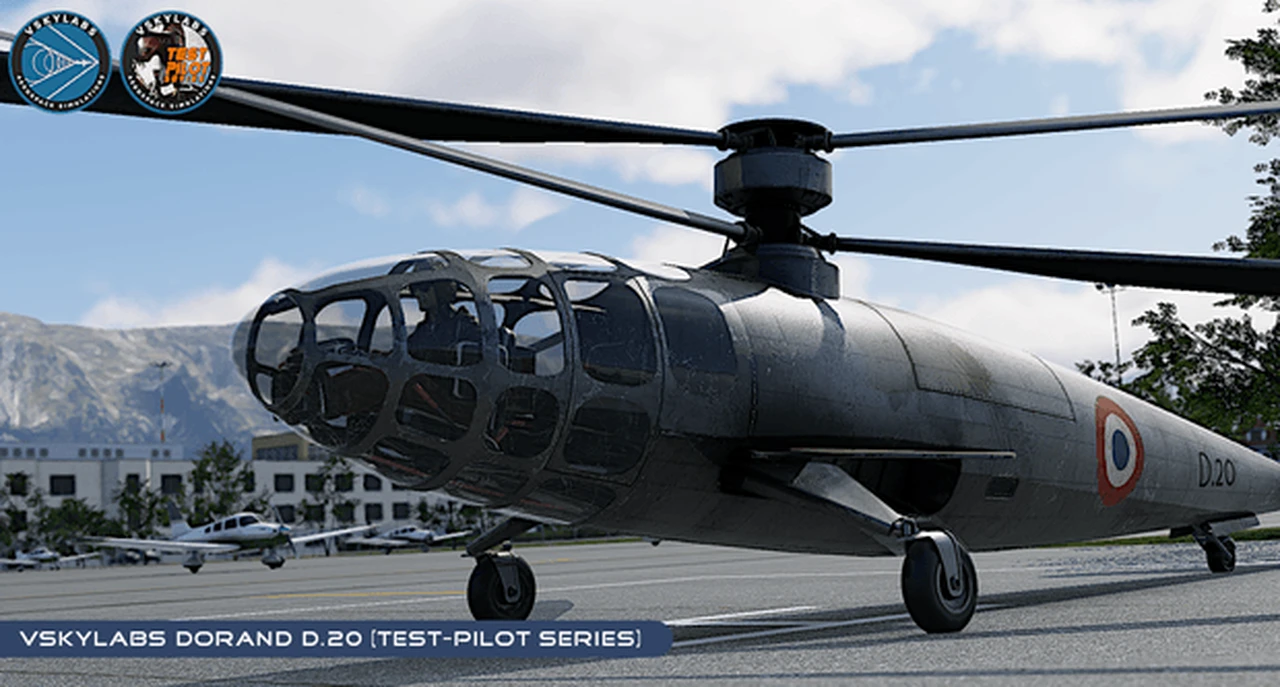
The Dorand D20 (cataloged across rotary-wing archives and simulation hangars as the Dorand G.20, Dorand G.II, and VSKYLABS D20) resurrects one of the most eccentric rotary-wing experiments of mid-century aviation. Conceived in the late 1930s by French aeronautical pioneer René Dorand for the Société Française du Gyroplane and commissioned by the French Navy, the G.20 was envisioned as an anti-submarine reconnaissance helicopter. Disrupted by World War II, construction dragged on until a single prototype was finally completed in 1947. While the aircraft underwent tiedown ground testing, it never made a free flight, leaving its actual airborne handling an unanswered historical question. VSKYLABS developed this freeware native X-Plane 12 release as part of their "XP-Native Projects" series, transforming archival engineering drafts into a functional flight-dynamics model.
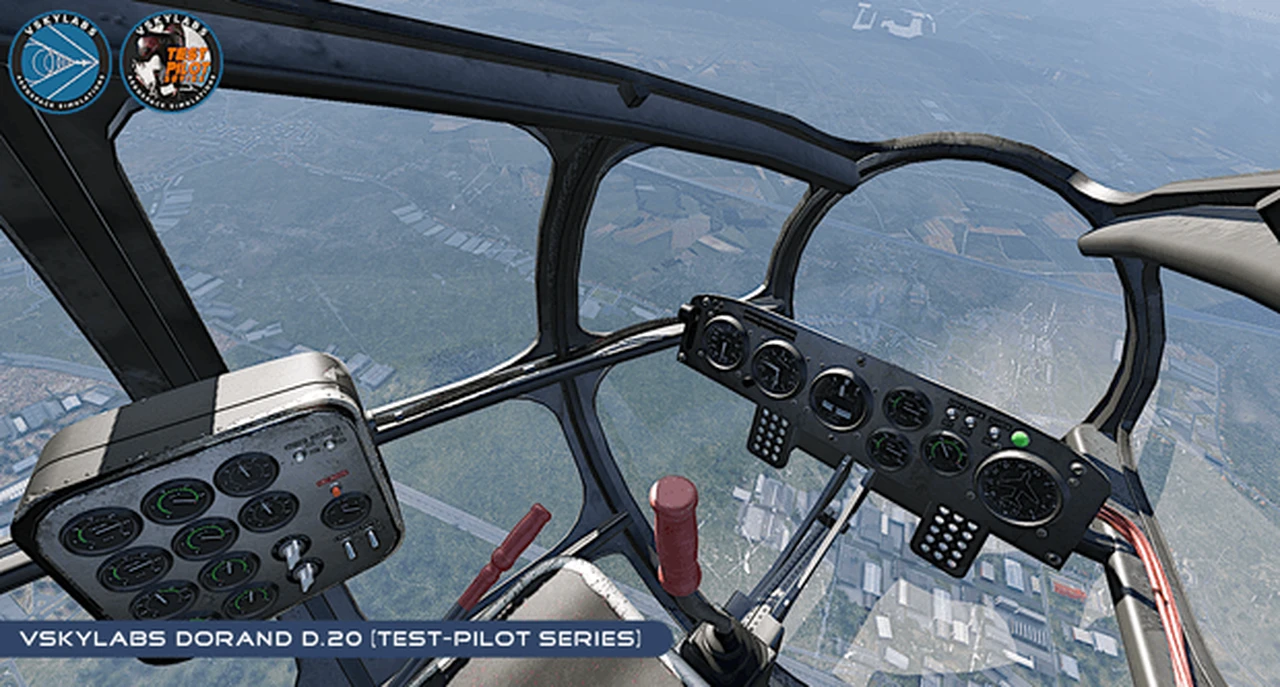
The defining characteristic of the D20 is its coaxial, contra-rotating rotor system. To eliminate the high tail-rotor power loss typical of conventional helicopters, the machine stacks two three-bladed rotors on a single mast. To prevent blade collisions with minimal vertical hub clearance, Dorand engineered differing rotor diameters: a 15.4-meter upper rotor and a 13.0-meter lower rotor, both driven through a central transmission by twin Renault 6Q inverted inline engines. The cockpit presents an authentic period workspace featuring basic French metric flight instruments, dual engine RPM indicators, manifold pressure dials, and conventional collective and cyclic controls.
In the X-Plane 12 flight environment, the D20 flies with the distinctive stability of a coaxial rotary platform. Because the twin contra-rotating discs neutralize torque, pedal control governs differential rotor pitch and directional rudders rather than an anti-torque tail rotor, resulting in minimal sideways drift during hover and transitional lift phases. Evaluated under our directory classification rubric, the aircraft sits in the Casual tier: designed as a streamlined testbed, it focuses on hands-on flight physics while keeping secondary systems and electrical breakers simplified to native simulator defaults. For rotorcraft pilots and aviation history buffs, this freeware curiosity offers an engaging glimpse into what mid-century French naval aviation envisioned before conventional helicopters dominated the skies.
Primary Missions & Operational Roles
-
Experimental Coaxial Rotary Flight Testing: Exploring the unique hover physics, pedal yaw response, and transitional lift behavior of a dual-rotor coaxial design without anti-torque drift.
-
Vintage Low-Altitude Coastal Patrols: Flying simulated post-war naval harbor and shoreline reconnaissance hops between 500 and 1,500 feet AGL at 60 to 80 knots.
-
Twin-Piston Engine Management: Coordinating startup, warm-up, and power delivery across twin synchronized Renault 6Q engines driving a shared rotor gearbox.
-
Rooftop & Confined-Area Hover Practice: Utilizing the compact airframe footprint of a tail-rotor-free helicopter to practice precision landings on hospital pads, docks, and tight clearings.
Key Highlights
- Completely free community project developed natively for X-Plane 12 under the VSKYLABS XP-Native initiative.
- Fascinating coaxial rotor aerodynamics modeling counter-rotating discs with asymmetric upper and lower rotor spans.
- Inherently stable hover characteristics due to torque neutralization, eliminating translational tail-rotor drift.
- Period-accurate post-war French cockpit aesthetic with functional metric dials and classic flying controls.
- High frame-rate performance and low hardware overhead due to efficient native modeling.
Quirks & Limitations
- Cockpit circuit breakers and electrical fuses are non-functional cosmetic fixtures.
- Conceptual flight dynamics model based on engineering projections since the real-world 1947 prototype only completed ground trials.
- Simplified avionics and systems depth built for hop-in-and-fly experimental testing rather than full SOP training.
- Lacks an integrated 3D tablet EFB or moving-map display, requiring external charts or third-party overlays for navigation.
Community Ratings & Feedback
Want to rate this flight deck or leave a review? Log In or Create an FSS Account to post your review.
Be the first simmer to leave a flight deck review and community score for this airframe.
Purchase & Download
Developer Store - VskyLabsSystems & Integrations
Video Showcases
Help Improve the Directory
Notice missing details, broken links, or incorrect pricing? Submit a correction to our Hangar Mods.
Suggest an Update