
Lockheed SR-71 Blackbird
Editorial Overview & Systems Analysis
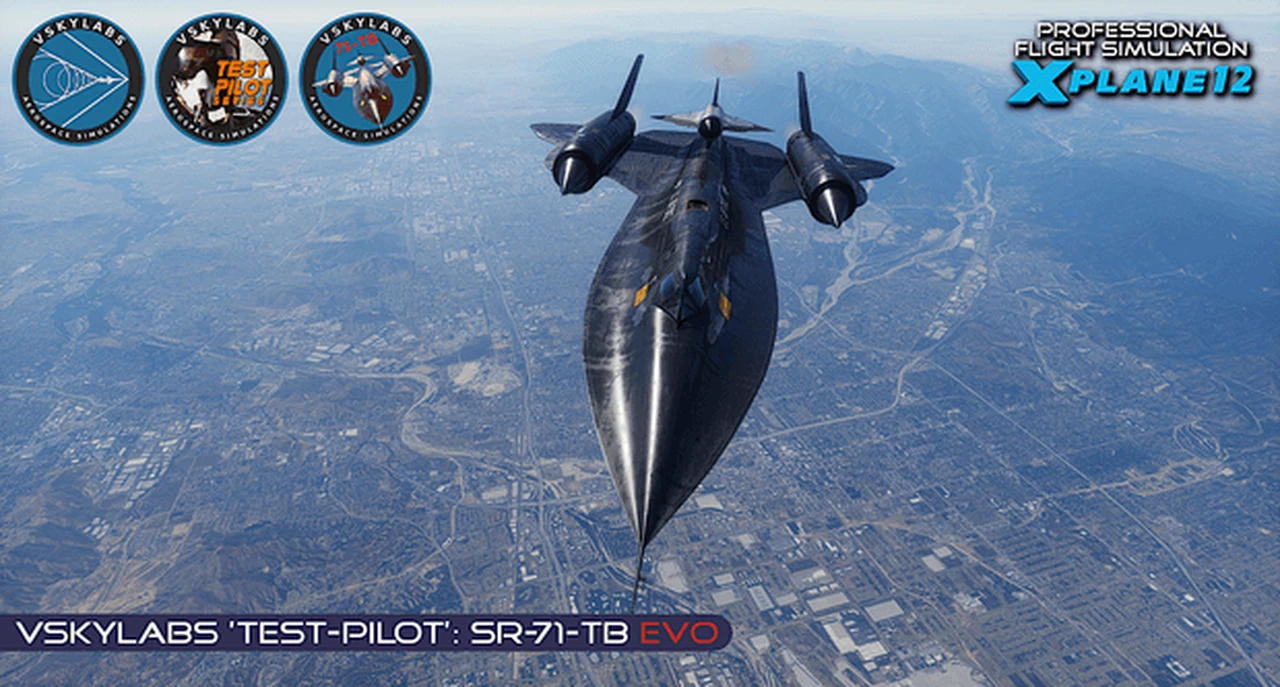
The Lockheed SR-71 Blackbird (universally immortalized across aviation history and simulation hangars as the SR-71, SR-71A, Blackbird, Habu, and XR-71-TB) represents the pinnacle of twentieth-century airbreathing aeronautical engineering. Developed in deep secrecy by Kelly Johnson and Lockheed's Skunk Works, the titanium reconnaissance icon was engineered to outrun surface-to-air missiles by cruising in excess of Mach 3.2 at altitudes above 80,000 feet. Studio VSKYLABS developed this native X-Plane 12 project under their "Test-Pilot" banner, releasing an ongoing research testbed simulation engineered around declassified USAF and NASA flight test data.
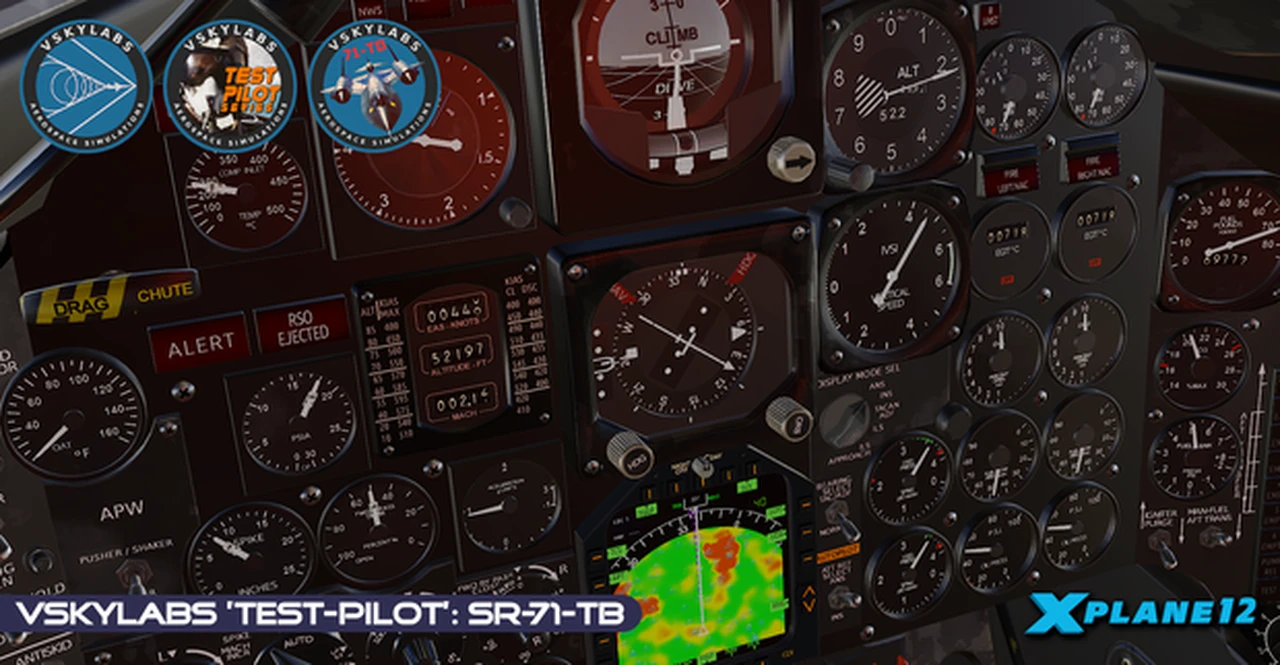
Simulating the Blackbird requires modeling propulsion physics that blur the line between a turbojet and a ramjet. The aircraft is powered by twin Pratt & Whitney J58 (JT11D-20) engines equipped with continuous-bleed bypass tubes and moveable conical inlet spikes. VSKYLABS models the automated spike translation and forward bypass doors that manage internal shockwaves at supersonic speeds, along with the Triethylborane (TEB) chemical injection shots required to ignite the afterburners. The cockpit features authentic systems logic including external AG-330 Buick V8 "start-cart" spin-up drills, nitrogen fuel-tank pressurization, center-of-gravity fuel transfer management, and an authentic stability augmentation system (SAS). Virtual pilots can also mount and launch an operational Lockheed D-21 Mach-3 parasitic reconnaissance drone from the rear fuselage.
In the X-Plane 12 flight environment, flying the Blackbird is a demanding exercise in high-speed energy management. Taking off with partial fuel loads requires immediate rendezvous with a KC-135Q tanker, featuring an interactive air-refueling mode complete with authentic radio communications provided by real-world high-time SR-71 pilot Lt. Col. BC Thomas. Navigating the climb corridor demands discipline: pilots must maintain roughly 450 Knots Equivalent Airspeed (KEAS) through the high-drag transonic region before riding the Mach 3.2 climb profile into the stratosphere. Evaluated under our directory rubric, the package earns a solid Procedural tier. While it delivers deep engine cycle mechanics and high-altitude flight physics, cockpit circuit breakers are non-functional cosmetic fixtures, and global navigation utilizes a modified default FMS as a modern substitute for the classified Astro-Inertial Navigation System (ANS). For simmers seeking to cruise along the edge of space at 2,100 miles per hour, this testbed delivers an exhilarating supersonic challenge.
Primary Missions & Operational Roles
-
Stratospheric Mach 3.2 Global Reconnaissance: Operating high-altitude strategic intelligence profiles between 75,000 and 85,000 feet MSL at speeds exceeding Mach 3.0 across multi-thousand-mile tracks.
-
In-Flight Aerial Refueling & Tanker Hookups: Executing rendezvous and plug-in refueling drills with tanker aircraft to top off JP-7 fuel reserves immediately following low-weight takeoff.
-
High-Speed Inlet & Shockwave Management: Managing engine inlet spikes, bypass doors, and TEB afterburner injection counters while avoiding dangerous high-Mach inlet unstarts.
-
Parasitic Drone Deployment: Launching the functional piggyback Lockheed D-21 Mach-3 drone at high altitude and monitoring the resulting aerodynamic center-of-gravity shift.
Key Highlights
- Detailed Pratt & Whitney J58 propulsion logic modeling moving inlet spikes, shockwave bypass doors, and limited TEB chemical afterburner ignition shots.
- Operational air-refueling mode complete with tanker visual modeling and authentic cockpit radio audio recorded by real-world SR-71 pilot Lt. Col. BC Thomas.
- Functional launchable Lockheed D-21 Mach-3 reconnaissance drone that dynamically affects airframe aerodynamics and weight and balance.
- External AG-330 starter cart simulation replicating the authentic dual-engine mechanical crank sequence required for startup.
- Multi-layered FMOD2 acoustic suite capturing external jet wash, afterburner roar, cockpit air pressurization, and canopy seal hiss.
- Dedicated VR optimization with integrated "Cockpit-Builders Heaven" custom control mapping layers.
Quirks & Limitations
- Cockpit circuit breakers and secondary electrical fuses are cosmetic fixtures rather than dynamic overcurrent devices.
- Classified Astro-Inertial Navigation System (ANS) is replaced by an integrated standard FMS unit for modern waypoint routing.
- Demanding transonic climb profile requires strict adherence to published KEAS climb tables to avoid running out of thrust or stalling at intermediate altitudes.
- High-Mach inlet unstarts can induce violent yaw moments if throttles are mishandled or if pitch angles change abruptly above Mach 2.8.
- Does not support automated direct SimBrief OFP operational flight plan downloads.
Community Ratings & Feedback
Want to rate this flight deck or leave a review? Log In or Create an FSS Account to post your review.
Be the first simmer to leave a flight deck review and community score for this airframe.
Systems & Integrations
Video Showcases
Help Improve the Directory
Notice missing details, broken links, or incorrect pricing? Submit a correction to our Hangar Mods.
Suggest an Update