
Douglas DC-3 Airliner
Media Gallery
Editorial Overview & Systems Analysis
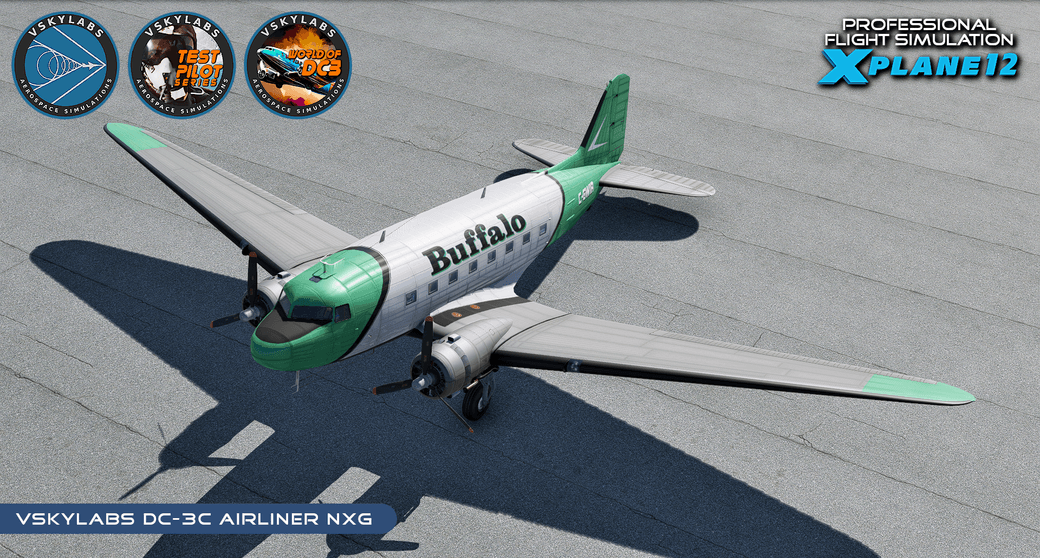
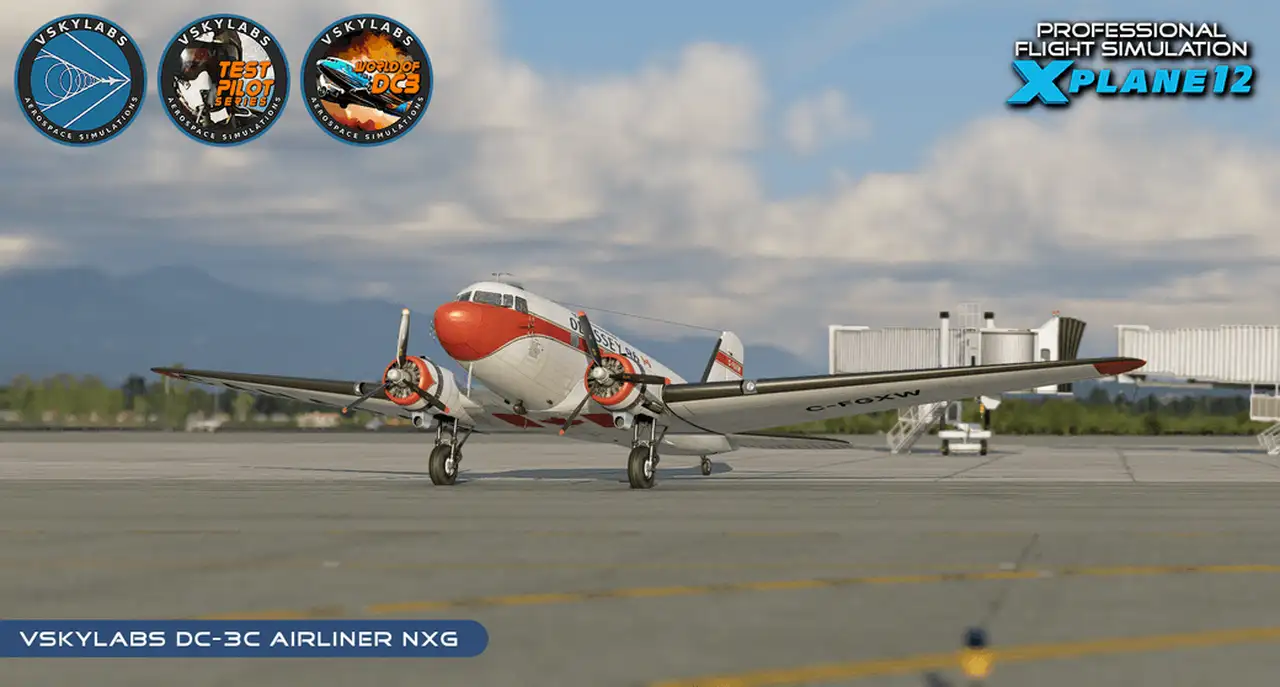
The Douglas DC-3 (universally celebrated throughout commercial aviation history and simulation hangars as the DC-3, C-47 Skytrain, Dakota, Gooney Bird, and VSKYLABS DC-3) is the aircraft that revolutionized passenger air travel in the 1930s. Designed by Donald Douglas and legendary aeronautical engineer Arthur Raymond, the twin-engine propliner made scheduled airline operations profitable for the first time without government mail subsidies. Developer VSKYLABS engineered this dedicated native X-Plane 12 project as a modern civilian "restomod" evolution. Rather than modeling an untouched 1930s museum artifact, the studio replicated the modern-day civilian airframes still actively hauling cargo and passengers across Canada, Alaska, and South America with glass retrofits.
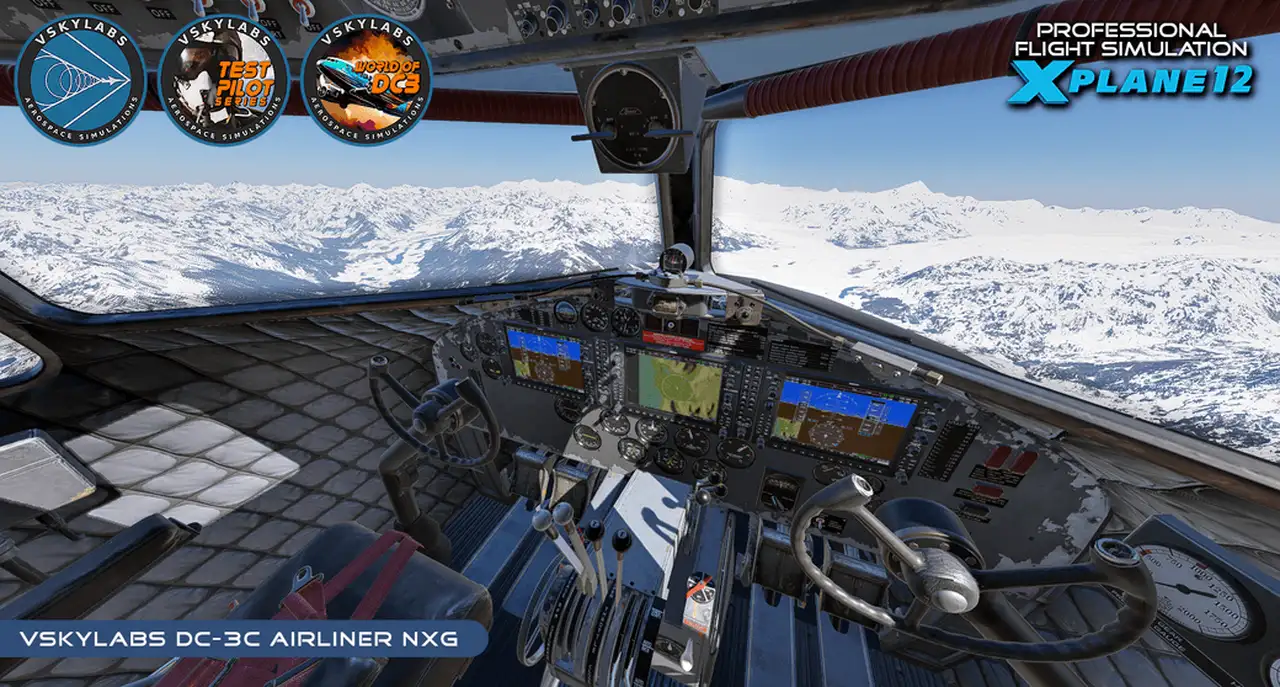
The flight deck combines vintage industrial utility with modern flight navigation. Analog engine instruments, classic hydraulic hand-pumps, and overhead cowl flap switches sit alongside a dual-display Garmin G1000 glass cockpit configuration. This hybrid layout gives virtual pilots modern moving-map terrain guidance, IFR route capabilities, and coupled autopilot modes, eliminating the high cockpit workload of vintage mechanical gyros while preserving the tactile essence of operating multi-engine radials. Cockpit interactions include custom rotary fuel selectors, cowl flap lever gates, pilot-side AviTab integration, and VSKYLABS' "Cockpit-Builders Heaven" custom control mapping layers.
In the X-Plane 12 flight environment, the VSKYLABS DC-3 delivers the heavy, raw taildragger handling that real-world C-47 captains revere. Powered by twin 1,200-horsepower Pratt & Whitney R-1830-92 Twin Wasp 14-cylinder radial engines, the aircraft cruises comfortably between 140 and 165 KTAS. Takeoff rolls demand deliberate rudder footwork and tailwheel lock engagement to counter twin propeller P-factor and torque. Ground friction dynamics model the massive main wheels and castoring tailwheel across unimproved tundra and grass strips, while the package includes functional deployable snow skis with tailored ski-on-snow friction physics. For pilots intimidated by the four-engine systems management of the DC-6, the VSKYLABS DC-3 strikes a balance between vintage round-engine charisma and accessible twin-engine flying.
Primary Missions & Operational Roles
-
Backcountry Arctic & Bush Freight Operations: Flying heavy cargo, fuel bladders, and supplies into remote Canadian or Alaskan gravel runways and frozen ice strips (recreating Buffalo Airways line runs).
-
Multi-Engine Radial Propliner Transition: Mastering twin-engine radial engine management, cylinder head temperature (CHT) monitoring, cowl flap modulation, and prop feathering.
-
Heavy Conventional Tailwheel Mastery: Practicing large-airframe taildragger takeoffs, tail-up wheel landings, three-point turf arrivals, and crosswind rudder coordination.
-
Regional Scenic Classic Airline Touring: Flying low-altitude passenger hops along coastal mountain ranges, Great Lakes corridors, and island archipelagos using the modernized G1000 moving map.
NOTE: While the underlying Pratt & Whitney radials and tailwheel handling require mechanical care, replacing the historic analog flight deck with a modern dual-screen Garmin G1000 effectively bypasses the crew coordination and procedural instrument workload authentic to a 1930s propliner, placing this hybrid restomod firmly in the Casual tier as an accessible backcountry cruiser.
Key Highlights
- Modernized Restomod Hybrid Cockpit: Blends authentic radial engine monitoring with a dual-screen Garmin G1000 suite for modern GPS and IFR route management.
- Authentic Radial Taildragger Physics: Tuned with real-world C-47 pilot feedback to accurately replicate high-torque takeoff rolls, tailwheel ground handling, and steep three-point flares.
- Deployable Arctic Skis with Dedicated Physics: Features animated undercarriage snow skis with authentic ski-surface friction for frozen lake and glacier landings.
- Deep FMOD2 Twin Wasp Acoustic Package: High-fidelity multi-layered radial engine audio featuring deep idling growls, supercharger harmonics, and propwash rumble.
- Simulated Engine Mishandling Consequences: Models simulated structural stress, thermal engine damage from persistent overboosting, and visual tire blowouts.
Quirks & Limitations
- Unconventional Hybrid Avionics for Purists: Traditional vintage purists seeking an original 1930s raw-vacuum Sperry gyro panel may find the modern G1000 screens immersion-breaking (VSKYLABS produces a separate C-47 military variant for historical analog panels).
- Demanding Crosswind Ground Rollout: The large fuselage acts as a weather vane; landing in crosswinds above 15 knots requires active differential braking and prompt tailwheel lock discipline to prevent ground loops.
- Heavy Elevator Forces During Low-Speed Flare: Trimming during the approach is essential; the elevators become heavy near idle power, demanding proactive nose-up trim before touching down.
- No Automated SimBrief Datalink: Flight plans cannot be imported automatically via ACARS/SimBrief; navigation routes must be entered into the G1000 manually or loaded using .fms flight files.
Community Ratings & Feedback
Want to rate this flight deck or leave a review? Log In or Create an FSS Account to post your review.
Be the first simmer to leave a flight deck review and community score for this airframe.
Systems & Integrations
Video Showcases
Help Improve the Directory
Notice missing details, broken links, or incorrect pricing? Submit a correction to our Hangar Mods.
Suggest an Update